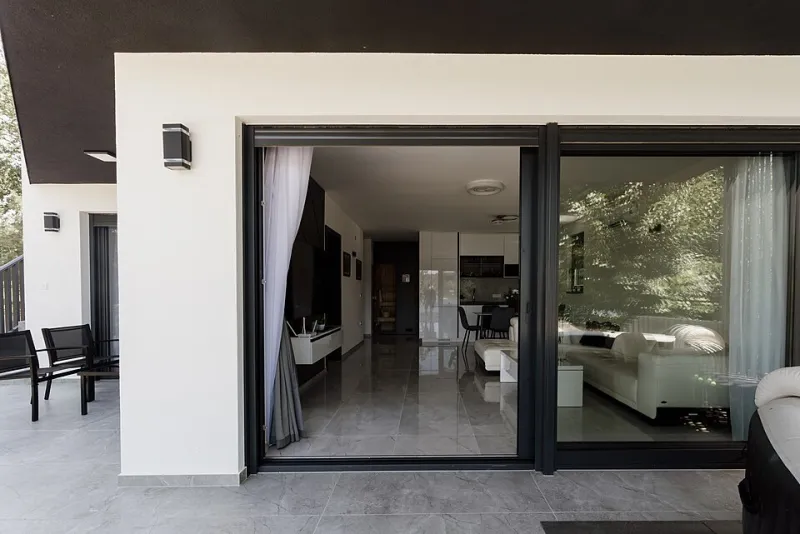
Track Marks and Stacking Space: Dressing a Patio Door Without Dimming the Room
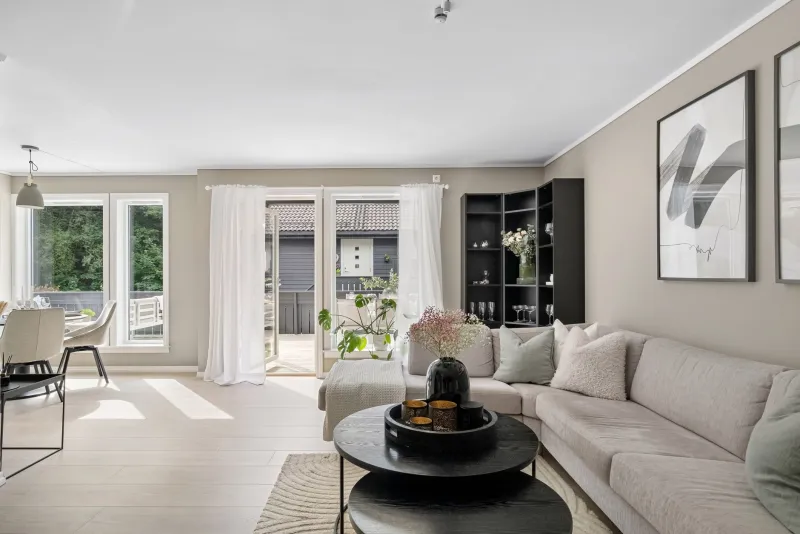
A patio door is a light machine. You paid for the glass, the slim frame, the low-iron pane, the whole bright-living pitch. Then a heavy curtain goes up across the opening and the room starts to feel like a cave by 3pm. This is not an argument against curtains. It is an argument for dressing the door with a bit of intent.
Start with the door, not the fabric
Sliding, bifold and French doors each change what is possible. A wide slider needs a track that runs the full width and a stack that sits clear of the glass. Bifolds need dressings that travel with the panels — clip-on blinds, integral blinds, or curtains on a track set well forward. French doors need clearance for the swing, the handles and the lock. Before you fall for a fabric, measure the opening, the frame, the wall space either side, the ceiling height, and the clearance above the door for a track. Note where the handle sits. Note the trickle vent. These details decide whether the dressing works or fights the door.
The stacking problem is the daylight problem
The biggest daylight thief is not the fabric itself; it is the stack. A curtain needs somewhere to go when it is open. On a wide slider, each curtain may need 20–30% of the door width to gather properly. If there is no wall space, that stack sits over the glass even on a bright afternoon. You end up with a permanent fabric pelmet across the top corner and a room that feels narrower than it is.
There are ways around this. Run the track past the frame and onto the wall so the curtains park off the glass. Use a ceiling-fixed track set forward of the frame so the fabric clears the door. If the door is only used from one side, a single stack at the far end can work. Or choose a blind that disappears into a cassette. What you should not accept is a track that stops at the frame — that guarantees the stack hangs over the glass.
Curtains: track versus pole
Poles look lovely in a photograph. On a patio door they are often a compromise. Brackets project, the curtains sit away from the glass, and the stack is bulkier. A ceiling-fixed track is more discreet, can be bent around a corner, and can even be recessed into a ceiling void. Wave headings need a specific track; pencil pleat is more forgiving; eyelets need a pole. For winter warmth, a track that sits close to the ceiling and returns to the wall reduces draughts. Thermal linings or interlining help, but blackout is not the same as thermal — one blocks light, the other slows heat loss. Check both if you care about January bills.
Blinds: the disappearing act
Vertical blinds are the classic slider solution: they stack tightly, tilt for privacy, and leave most of the glass clear when open. Cheap ones clatter in a draught, so buy better. Pleated and roller blinds stack at the top, which can create a light-blocking band across the head of the door. Cellular or honeycomb blinds insulate well but are bulky. Day-and-night blinds give flexibility. Integral blinds sealed inside the glass are neat, dust-free and ideal for bifolds and sliders, but you need to specify them when buying the door — retrofitting is limited. For bifolds, look at clip-on systems designed for the panel rather than window-style frames that stop the door folding flat.
Shutters: beautiful, but be honest about the light
Plantation shutters on patio doors look smart and offer adjustable privacy. Full-height shutters with split tilt let you open the top louvres and keep the bottom closed. But even with the louvres open, they cut light. If the patio door is the main source of daylight in a north-facing living room, shutters may be a compromise too far. Tier-on-tier or café-style shutters preserve the top of the glass. Tracked shutters for bifolds exist but are expensive and add weight to the panels — check the door’s operating limits before you commit.
The safety bit nobody wants to read
Cords and chains are the thing to get right. UK rules require safety devices — cleats, breakaway connectors, tensioners — or cordless and motorised operation. On a patio door, a looped cord near a low handle is a genuine risk for toddlers and pets. Ask for cordless, spring-loaded or motorised. A floor-length curtain can also become a climbing frame, so consider a blind with a bottom bar that sits above the floor. Safety is not the glamorous part of soft furnishings, but it is the part you will remember if something goes wrong.
Warmth without the fusty room
Thermal dressings help, but they can also trap moisture. Patio doors are often the coldest glass in the room, so condensation is normal. Keep a gap between the fabric and the glass, open the dressings daily, and use the trickle vents. Do not seal the door with a blind cassette and then wonder why the room smells damp. A well-fitted thermal curtain on a ceiling track can reduce draughts, but it cannot replace ventilation.
The final check before you buy
Measure twice. Check the stack. Check the handle clearance. Check the door swing. Check that the track can be fixed safely to the ceiling or wall. Check the cord safety. Check the fabric can be cleaned. Then ask yourself one question: when the dressings are fully open, how much glass can I actually see? If the answer is ‘not much’, you are giving back the light. Dress the door, by all means — just do not let the dressing undo the reason you bought it.