Crunching the Patio Door Numbers: What Glazing Really Returns on Your EPC, Your Bills and Your Sale Price

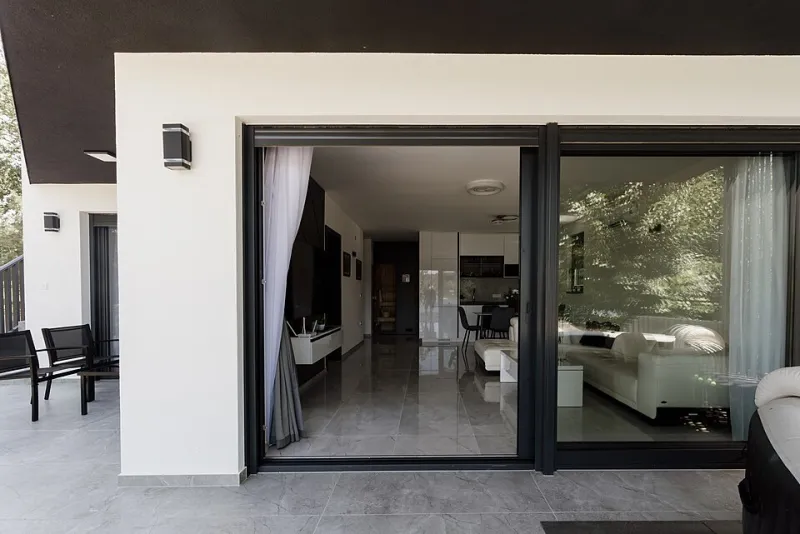
Photo: modern aluminium sliding patio doors open onto a UK garden, sunlight falling on wooden floorboards, bright living room, via i.pinimg.com
There is a line that appears in almost every patio door quote, usually near the bottom in a slightly larger font: adds value to your home. It might well. But it is worth pinning that claim down to actual numbers before you sign, because the payback on glazing is far less uniform than the sales patter suggests — and the differences between one specification and another are where the real money sits.
So let's do the sums properly, in the least exciting way possible.
First, what actually lands on the EPC
An Energy Performance Certificate is produced from a Standard Assessment Procedure calculation of the whole dwelling. Your rear door is a small part of that picture — typically two to four square metres of glass and frame in a house that might have eighty square metres of external envelope. That matters, because it sets expectations. Swapping one tired door will nudge the score; it will not transform it.
What the assessor cares about is the U-value: the rate at which heat escapes per square metre per degree of temperature difference. A single-glazed timber door from the 1970s might sit around 4.8 to 5.4. A decent modern double-glazed patio door is usually in the 1.3 to 1.4 bracket. The very best triple-glazed units get down towards 0.8.
Run the arithmetic on a three-square-metre door, and going from 5.0 to 1.35 saves roughly 3.65 watts for every degree of temperature difference between inside and out. Over a UK heating season that adds up to somewhere in the region of 500 to 550 kilowatt hours a year — call it £30 to £55 on a gas boiler, or £110 to £140 if you heat with electricity or a heat pump on a standard tariff. Not nothing. Also not a new kitchen.
Where the EPC point genuinely bites is at the band boundaries. If your home is sitting on a high D, a new door plus a couple of other small measures can tip it into a C — and C is the number that matters for rented property standards, for a growing number of green mortgage products, and increasingly for buyer confidence. Moving from a C to a B on the back of one door? Unlikely.
The free heat nobody puts on the quote
Here is the part that gets left out of the energy conversation entirely: south and west-facing glazing collects solar heat. A well-oriented patio door with a decent g-value contributes genuinely useful warmth in spring and autumn, reducing the hours your heating runs. In a typical UK home that contribution can be worth more than the U-value improvement, particularly in a shoulder season like October or March.
The catch is the other end of the year. The same glass that helps in April becomes a liability in July, and a west-facing wall of glazing can turn a sitting room into a greenhouse by mid-afternoon. If the door faces the afternoon sun, solar control glass with a lower g-value is worth the modest uplift — and no, it does not make the room gloomy, whatever your fitter's mate told you.
What buyers and estate agents actually do with a glazed rear wall
Estate agents love a garden connection. It photographs beautifully, it appears in the first three lines of a listing, and it makes a floor plan read as generous rather than hemmed in. Expect language about light, flow and indoor-outdoor living, and expect it to help a property get viewings.
What a valuer will not do is add a line item for your door. Surveyors work from comparable sales, not from a specification sheet. So the uplift is real but indirect: a brighter, better-connected rear reception room tends to be viewed as a better room, and better rooms support better asking prices. There is no honest way to isolate a figure for that, and anyone who quotes you one is guessing.
Where a new door does pay back almost immediately is at the tired end of the market — a 1980s aluminium slider with misted sealed units, a draughty threshold and a handle that needs two hands. That door drags a room down in every viewing. Replace it and the room reads as finished.
Where the money works hardest
| Specification choice | Typical extra cost | What it buys | Verdict |
|---|---|---|---|
| Thermally broken aluminium frame | Moderate | Slim sightlines, long life, real thermal performance | Worth it if you want the look |
| Multi-chamber uPVC | Low | Solid U-values at modest cost | The value pick |
| Argon fill and warm-edge spacer | Small | Meaningful U-value gain for pennies | Say yes |
| Triple glazing | Substantial | Marginal thermal gain, big acoustic gain | Justified for noise, not for bills |
| Low aluminium threshold with drainage | Moderate | Step-free access, airtightness | Do it once, properly |
| Cheap frame, premium glass | — | Best glass in the world, ruined by a poor frame | Avoid |
The bit that quietly undoes everything
You can buy a superb door and lose most of the benefit at the perimeter. A poorly sealed frame, gaps behind the reveal, an untaped threshold, or a cavity left open around the lintel will leak more heat than the glazing saves. Ask your installer, plainly, how they seal and tape the opening — and get it in writing. Compressible foam tape, airtightness membrane and a properly drained threshold are unglamorous, cheap and by far the highest-return items on the whole job.
A rough payback sketch
Take a three-metre sliding door at £4,000 supplied and fitted, replacing a failing single-glazed unit in a gas-heated home. Annual heating saving: perhaps £45. Solar gain benefit: maybe another £20 to £40, depending on orientation. That is not a payback story on energy alone — you would be waiting decades. Add the resale effect, the comfort, the draught you no longer feel at ankle height, and the room you actually use in January, and the case looks different. But it is a comfort-and-value purchase, not an investment that pays for itself in saved gas.
The honest position for 2026: buy a patio door because you want a better room, a brighter connection to the garden and a fabric that will still be sound in twenty years. Choose your specification on that basis, take the energy saving as a welcome bonus, and ignore anyone who tells you the door will pay for itself. It won't. It will, however, be the change you notice every single day — and that is a different kind of return.