Turning Down the Traffic: Specifying a Patio Door That Actually Quiets a Busy Road
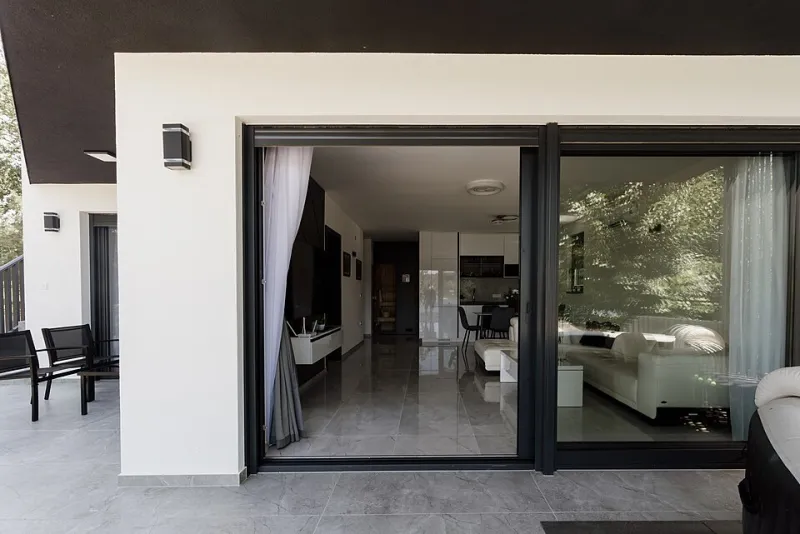
Photo: Shixart1985, CC BY 2.0, via Wikimedia Commons
Most homeowners come to acoustic glazing with a single wish: make the traffic go away. On a busy UK road, that is a tall order. A patio door can take the edge off tyre roar, engine drone and the 6am bin lorry, but it will not turn a street-facing lounge into a recording studio. The useful question is not 'Is this door quiet?' but 'How much noise is this whole door assembly likely to keep out, and at what cost?'
Start with the noise, not the brochure
Traffic noise is not one sound. There is the high-frequency hiss of wet tyres, the lower rumble of diesel engines and the occasional sharp clatter of a skip lorry. Low-frequency sound is the awkward one. It travels through gaps, around seals and through the weakest part of any wall. That is why a patio door with excellent glass but a poorly fitted frame can still let in more noise than the homeowner expects.
Before choosing a product, listen to where the noise actually enters the room. Is it coming through the glass, around the door edge, through a trickle vent or under the cill? If the adjacent wall is a single-skin Victorian brick or a 1930s cavity that was never filled, a new door alone may disappoint. A sensible installer will talk about the whole opening, not just the sealed unit.
Glass is where most of the work happens
Acoustic performance starts with the glazing. Standard double glazing helps, but it is not automatically acoustic glazing. The most common upgrade is laminated glass with a specialist acoustic interlayer. This damps vibration and is particularly useful against traffic noise. You will see descriptions such as 6.4mm, 8.8mm or 10.8mm laminated glass, where the number refers to the overall glass and interlayer thickness.
Asymmetric units also appear in good specifications. Pairing a thicker pane with a thinner one can reduce the resonance that occurs when two identical panes vibrate together. A typical acoustic double-glazed unit might use a 10mm or 12mm pane on one side and a 6.4mm or 8.8mm laminated pane on the other, with a generous cavity between them. Triple glazing can help, but it is not a magic fix. More glass and more weight need stronger frames, better hinges and hardware that can cope.
Ignore any claim that simply says 'reduces noise by X decibels' without context. Acoustic ratings are usually expressed as Rw, with a traffic-noise adjustment called Ctr. The Rw figure tells you about laboratory performance across a range of frequencies; Ctr tells you how well the product deals with low-frequency urban noise. A product with a respectable Rw but a poor Ctr may still struggle with a busy A-road.
The frame and seals matter as much as the glass
A patio door is a system. The frame material, profile design and seals all affect how much sound reaches the room. Multi-chamber uPVC frames can perform well when they are rigid and well made. Aluminium is strong and slim, but it needs proper thermal breaks and careful detailing because metal transmits vibration. Timber frames can be excellent, though movement and maintenance matter over time.
Seals are the quiet heroes. Sliding doors rely on overlapping seals and brushes; bifold doors have more joints and more places for sound to leak. French doors need compression seals that actually compress. Look for continuous seals, decent weatherpile and a door that closes firmly without being forced. A beautiful acoustic unit fitted with a draughty frame is simply an expensive window with a gap around it.
Do not seal yourself into a stuffy room
This is the part buyers often miss. If you upgrade the glass and seals, you also reduce natural ventilation. Homes need background ventilation, and trickle vents are still part of the Building Regulations story in England and Wales. Blocking them up to keep out noise is a bad trade: you get condensation, stale air and sometimes a damp problem that costs more than the door.
Acoustic trickle vents exist, and they can help. They are not silent, but a well-designed vent with acoustic baffles is usually better than a standard slot vent. Ask the installer how the ventilation strategy works with the new door. If the room has no other opening window, you need a proper answer, not a shrug.
What decibel reduction can realistically deliver
A 10dB reduction is often described as roughly halving perceived loudness, but human hearing and traffic noise are complicated. A door that performs well in a test lab may deliver less in a real wall with a letterbox, an airbrick and a nearby wheelie bin. Expect an improvement, not silence. On a genuinely busy road, the difference may be that you can watch television at normal volume or hold a conversation without raising your voice. That is worth having. It is not the same as moving to a cul-de-sac.
Questions to ask before you buy
Ask the installer for whole-unit acoustic test data, not just the glass supplier's brochure. Ask what Rw and Ctr figures are claimed for the complete door set, including the frame and any ventilation. Ask how the door will be installed and whether they will seal the gap between frame and wall properly. Ask what happens if the door is draughty after fitting. Ask about the guarantee: does it cover the seals and hardware as well as the glass?
Finally, ask yourself whether the road noise is constant or occasional. A bedroom facing a commuter route at 7am has different needs from a garden room used at weekends. Be honest about the goal, and you are more likely to spend money on the parts that actually make a difference.
The honest bottom line
A quieter patio door is a worthwhile investment on a noisy UK street, but it works best as a package: acoustic laminated glass, a rigid frame, good compression seals and sensible ventilation. Buy the system, not the slogan. And if an installer promises that one upgrade will banish traffic noise completely, keep your wallet closed and ask for the test certificate.